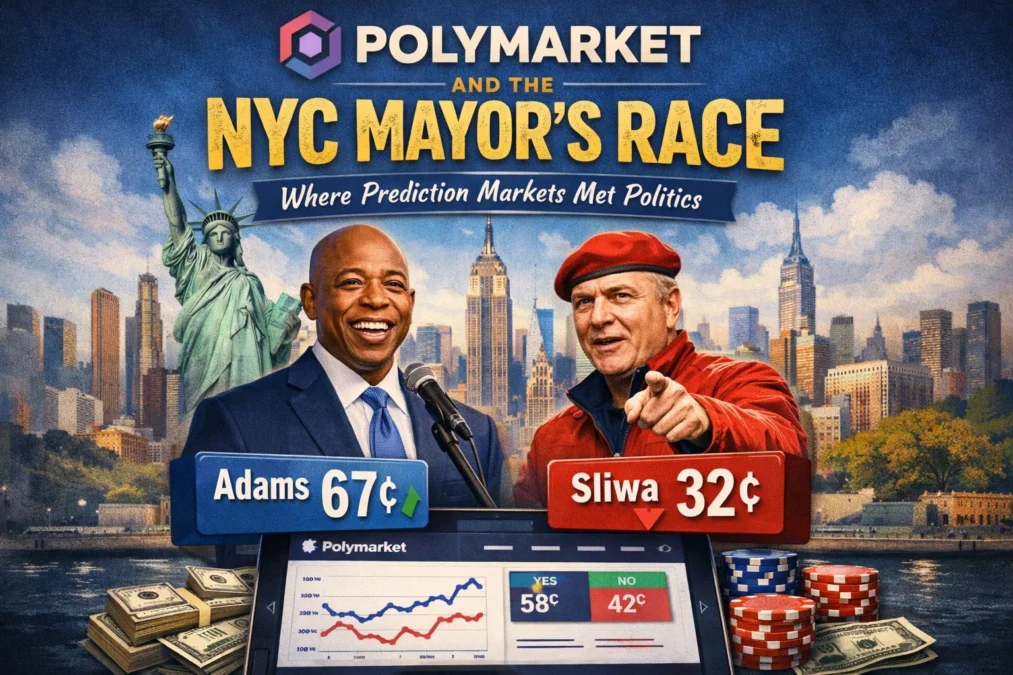

Polymarket and the NYC Mayor’s Race: Imagine if the noisy, chaotic, and endlessly analyzed spectacle of a New York City mayoral election could be distilled into a single, constantly updating number a live probability, fueled by real money, showing who the crowd truly believes will win. This isn’t a thought experiment from a political science lab; it happened. During the pivotal 2021 Democratic primary and the subsequent general election, a platform called Polymarket NYC Mayor markets became an unlikely but fascinating source of insight, controversy, and conversation. While pundits argued on cable news and pollsters scrambled to adjust their models, a global community of bettors placed real cryptocurrency on the outcome, creating a dynamic, unorthodox forecast that often moved faster than traditional media. This is the story of how prediction markets crashed the party of one of the world’s most scrutinized political contests, what they got right, what they got wrong, and what their growing presence signals for the future of how we understand elections.
To the uninitiated, Polymarket might sound like just another betting site. But it operates on a fundamentally different premise: it’s a decentralized information market built on blockchain technology. Instead of betting on sports, users buy and sell “shares” in the outcome of real-world events, from “Will the Fed raise rates?” to “Will this movie win an Oscar?” The price of a share directly translates to the market’s collective probability. If a share for “Eric Adams wins NYC Mayor” is trading at $0.70, the market believes he has a 70% chance. This concept isn’t new futures markets have predicted events for centuries but applying it so directly to a live political election via crypto was a bold, and for some, alarming, innovation. The Polymarket NYC Mayor contracts became a lightning rod, drawing attention not just from political junkies and crypto enthusiasts, but also from regulators concerned about the very idea of gambling on democratic outcomes. This article will pull back the curtain on this intriguing intersection of finance, technology, and politics.
Polymarket and the NYC Mayor’s Race: The Rise of Prediction Markets and Polymarket’s Entry
Prediction markets have a long, if niche, academic history. The core idea is the “wisdom of the crowd”: aggregating diverse, independent opinions, especially when those opinions have a financial stake (or “skin in the game”), often produces remarkably accurate forecasts. Famous examples include the Iowa Electronic Markets, which have often outperformed polls in predicting U.S. presidential elections, and the Hollywood Stock Exchange, which adeptly forecasts Oscar winners. These markets work because they incentivize truth-seeking; it’s profitable to be correct and costly to be wrong. For years, however, these markets existed in a legal gray area in the U.S., limited mostly to research or play-money environments due to strict gambling laws.
Enter Polymarket, founded in 2020. It leveraged two key innovations to bypass traditional hurdles. First, it was built on the Polygon blockchain, making it global, decentralized, and accessible to anyone with an internet connection and cryptocurrency. Second, it framed itself not as a gambling site, but as a platform for “information markets,” a place to trade on your knowledge of the world. This technological leap allowed it to scale rapidly. When the 2021 New York City mayoral race began heating up—a wide-open contest following Bill de Blasio’s tenure—it was a perfect test case for Polymarket. The race was complex, featuring a new ranked-choice voting system, a large and diverse field of candidates, and a city at a crossroads recovering from the pandemic. Traditional polling was struggling to capture the nuances. Polymarket saw an opportunity and launched specific contracts for the Democratic primary, effectively creating a real-time, crowd-sourced probability engine for the Polymarket NYC Mayor outcome.
The 2021 Democratic Primary: A Chaotic Forecast
The Democratic primary for NYC Mayor was a political rollercoaster, and the Polymarket reflected every twist and turn. Early in the race, the market was highly volatile, with probabilities shifting dramatically based on endorsements, scandals, and debate performances. At various points, several candidates saw their stock rise: Andrew Yang, with his high national name recognition, initially traded high; Kathryn Garcia gained momentum as a competent manager; Maya Wiley surged with progressive backing. But throughout the turmoil, one candidate consistently maintained a strong position on the Polymarket NYC Mayor contracts: Eric Adams.
The market’s behavior during the ranked-choice voting tabulation was particularly fascinating. After election day on June 22nd, with only first-choice votes counted, Adams led but without a majority. The weeks-long process of eliminating candidates and redistributing their votes was a masterclass in uncertainty. Traditional media could only speculate, but Polymarket provided a minute-by-minute sentiment gauge. As each round of elimination was simulated and leaked, the market prices jittered. Adams’ probability would dip slightly when Garcia gained votes from Wiley’s elimination, then solidify again. The Polymarket NYC Mayor market, in essence, was acting as a real-time interpreter of the complex, unfamiliar RCV process for its users. It ultimately called the race for Adams with high confidence well before the Board of Elections made the official announcement, showcasing prediction markets’ potential to synthesize fragmented information quickly.
How Polymarket Stacks Up Against Polls and Pundits
So, was the crowd on Polymarket smarter than the pollsters and talking heads? The answer is nuanced. In the final stretch of the primary, the Polymarket NYC Mayor market correctly identified Eric Adams as the clear favorite. His contract price was consistently higher than what a simple translation of polling percentages might have suggested. This is because prediction markets incorporate more than just polling; they factor in fundraising strength, ground game, institutional support (like key union endorsements Adams secured), and the strategic realities of ranked-choice voting. While some polls showed a tight race between Adams, Wiley, and Garcia, the market bettors seemed to believe in Adams’ coalition of working-class Black and brown voters and his moderate “get stuff done” message as the winning combination.
However, it’s crucial to remember that prediction markets like Polymarket are not omniscient. They can be swept up in hype and misinformation just like any other forum. Early overconfidence in Andrew Yang’s chances is a prime example. His market price was inflated by his online popularity, particularly within the crypto-savvy demographic that overlaps with Polymarket users. This introduces a potential bias: a market can become an echo chamber for its own user base’s beliefs. Furthermore, these markets are susceptible to manipulation through large, strategically placed bets designed to sway perception a tactic known as “pumping.” While costly for the manipulator if wrong, it can create short-term distortions. The table below summarizes key comparisons:
| Forecasting Method | Strengths in the NYC Mayor Race | Weaknesses in the NYC Mayor Race |
| Traditional Polling | Measured demographic representation, snapshot of voter intent. | Struggled with modeling ranked-choice preferences, speed of release. |
| Pundit Analysis | Provided context, historical knowledge, and understanding of NYC’s political machine. | Often biased by narrative, slow to adapt to shifting dynamics. |
| Polymarket Prediction Markets | Real-time synthesis of all information (polls, news, sentiment), “skin in the game” incentive. | Potential user-base bias, vulnerability to short-term manipulation, and regulatory uncertainty. |
As one political data scientist observed, “Polymarket during the NYC mayor race was like a fever chart for the political insider’s subconscious. It didn’t always know why something was happening, but it felt the temperature change instantly.”
The Legal and Ethical Firestorm
The visibility of the Polymarket NYC Mayor markets did not go unnoticed by authorities. In the fall of 2021, the U.S. Commodity Futures Trading Commission (CFTC) took action. They charged Polymarket with operating an unregistered exchange and offering illegal off-exchange event-based binary options contracts. The core of the issue was legal classification: was Polymarket a useful information tool, or was it simply online gambling on political events? The CFTC came down firmly on the latter, forcing Polymarket to pay a fine and shut down all markets not compliant with U.S. regulations, which included all political event contracts. This was a major blow and set a clear, if controversial, boundary.
The ethical debate rages on. Critics argue that allowing real-money betting on elections is inherently corrosive to democracy. It could incentivize bad actors to spread misinformation to profit from market moves, or worse, to attempt to influence the outcome of an election for financial gain. The idea of profiting from a political outcome strikes many as unseemly, blurring the line between civic participation and financial speculation. Proponents, however, fire back that prediction markets are a form of free speech and information aggregation, more transparent and efficient than the opaque world of political consulting and insider punditry. They ask: Is it less ethical than betting on sports? Or is the real concern that these markets, by being often accurate, threaten established institutions like polling firms and media prognosticators? The Polymarket NYC Mayor case became the central battleground for this debate.
The Mechanics: How to “Bet” on a Political Future
Understanding how users actually interacted with the Polymarket NYC Mayor contracts demystifies the process. It wasn’t about placing a simple bet like at a sportsbook. Users connected a crypto wallet (like MetaMask) to the Polymarket site. They would then deposit USDC, a dollar-pegged stablecoin. In the market for “Who will win the 2021 New York City Democratic mayoral primary?” there would be a series of “outcome shares” for each major candidate.
Let’s say you believed Eric Adams would win. If his shares were trading at $0.60 (implying a 60% chance), you could buy 10 shares for $6.00. If Adams won, each of those shares would be redeemed for $1.00, so you’d get $10.00 back, netting a $4.00 profit (minus small fees). If he lost, your shares would be worth $0, and you’d lose your $6.00 stake. You could also sell shares short if you thought Adams was overvalued at $0.60, you could sell shares you didn’t own, hoping to buy them back later at a lower price. This continuous buying and selling by thousands of users is what creates the live probability. It’s a dynamic, two-way market more akin to trading a stock than placing a parlay. For the Polymarket NYC Mayor markets, this created a liquid, 24/7 trading environment where news about a scandal, a gaffe, or a key endorsement would be priced in within minutes.
The User Base: Who Was Really Trading?
Who were the people deciding these probabilities on the Polymarket NYC Mayor contracts? The user base was likely a specific and not-representative slice of the global population. First and foremost, they were cryptocurrency natives. Navigating blockchain wallets, understanding gas fees, and holding stablecoins requires a level of tech and financial savvy that excludes most of the general public. This almost certainly skewed the demographic toward younger, male, and financially oriented individuals. This is a critical point when assessing the market’s accuracy: its “crowd” was not a random sample of New York voters, or even the American public. It was a global crowd of crypto-enthusiasts with an interest in politics and speculation.
This composition introduces clear biases. This group might overvalue candidates who are tech-friendly or have name recognition in online circles (hence Yang’s early spike). They might be more libertarian-leaning and skeptical of traditional progressive candidates. However, the “skin in the game” factor is a powerful counterbalance. To risk real money, users are incentivized to seek out the best information, regardless of their personal biases. They might personally prefer Maya Wiley, but if the data suggests Adams will win, trading on that belief is profitable. This constant tug-of-war between demographic bias and financial incentive is what makes prediction markets so interesting to study. The Polymarket NYC Mayor market was, in effect, the collective intelligence and idiosyncrasies of this unique online tribe.
Beyond the Mayor: Polymarket’s Broader Political Forays
While the NYC Mayor race was a headline-grabbing event, Polymarket has hosted markets on a vast array of political events globally, from the 2020 U.S. Presidential election (where it performed very accurately) to the outbreak of war in Ukraine, to parliamentary elections in Europe and Asia. This global reach demonstrates the platform’s ambition to become a universal information oracle. Each of these markets serves as a small experiment in crowd-sourced forecasting. Interestingly, Polymarket has often shown a remarkable ability to quickly incorporate breaking news and geopolitical shifts, sometimes moving hours ahead of major financial markets in its probability assessments for conflict-related events.
The platform has also experimented with markets on legislative outcomes (“Will the infrastructure bill pass?”), Supreme Court decisions, and even geopolitical stability. This raises profound questions: Could such markets be used by organizations or governments as a planning tool? If a Polymarket-style probability for a foreign policy event spikes, should intelligence agencies take note? While the CFTC action has limited U.S. political event contracts, these markets continue elsewhere, creating a parallel, unofficial forecasting universe. The data generated is a treasure trove for researchers studying collective intelligence, misinformation propagation, and behavioral economics, with the Polymarket NYC Mayor episode serving as a rich, high-profile case study.
The Future of Prediction Markets in Politics
What does the future hold for platforms like Polymarket in the political sphere? The regulatory environment in the United States remains the largest hurdle. The CFTC’s action set a precedent, but the debate is not settled. There is ongoing advocacy, often from libertarian and tech circles, to create a legal framework for “prediction markets” separate from “gambling,” arguing for their social utility as information tools. A regulated, U.S.-based prediction market for economic indicators or even (contentiously) elections is not unimaginable, though it would face fierce opposition.
Technologically, the march forward is certain. Decentralized platforms built on blockchain will continue to operate globally, regardless of any single country’s regulations. Their sophistication will only grow, with more complex conditional markets and deeper liquidity. We may see the emergence of “decision markets” used internally by corporations for project forecasting, or by research institutions. In politics, their role will likely remain in the informal, shadow space closely watched by insiders, journalists, and data geeks, but not officially sanctioned. They will be a cryptic, real-time commentary track on the political process, a digitized version of the betting odds that have long been quoted in British elections. The Polymarket NYC Mayor experiment proved there’s both a demand for and a controversy around this form of political engagement, ensuring its story is far from over.
A Tool for Insight, Not a Crystal Ball
The key takeaway for any observer is to understand what prediction markets are and what they are not. They are not infallible crystal balls, nor are they replacements for rigorous polling, reporting, and democratic participation. The Polymarket NYC Mayor market was, at its core, a remarkable aggregator of dispersed information. It forced its participants to put their money where their mouth was, creating a powerful incentive to be right. In a fast-moving, complex election like the 2021 Democratic primary, it served as a valuable, if imperfect, supplementary data point a sentiment analyzer for a specific, engaged subset of the world.
However, treating its probability as gospel is a mistake. These markets are susceptible to manipulation, bias, and herd behavior. They can be wrong, and sometimes spectacularly so, especially in low-information or high-volatility environments. Their greatest strength the ability to synthesize information quickly is also a weakness, as they can overreact to single news headlines. The wise consumer of political information uses tools like Polymarket as one piece of a much larger puzzle, a piece that offers a unique, quantified, and real-time perspective on the ever-shifting landscape of political possibility.
Conclusion
The story of Polymarket and the New York City mayor’s race is a quintessential tale of the digital age: an innovative technology colliding with a centuries-old democratic institution, sparking fascination, utility, and outrage in equal measure. It demonstrated that in our hyper-connected world, the desire to forecast and engage with political outcomes can manifest in radically new forms, from tapping on a smartphone screen to trading crypto shares. The Polymarket NYC Mayor markets provided a riveting, real-time narrative of a historic election, offering a crowd-sourced probability that cut through the noise and, in the end, correctly identified the winner.
Yet, this experiment also laid bare significant challenges. Regulatory bodies saw not a novel information tool, but an unlicensed gambling operation. Ethicists questioned the implications of monetizing political belief. The episode forces us to confront difficult questions about the future of information, speculation, and democracy itself. Whether one views Polymarket as a dangerous diversion or a revolutionary forecasting tool, its foray into the NYC mayor’s race proved that prediction markets are now a part of the political conversation. They represent a new, uncertain, and undeniably powerful layer in how we attempt to understand the uncertain future, one trade at a time.
Frequently Asked Questions
What exactly was Polymarket predicting in the NYC Mayor’s race?
Polymarket was not predicting a specific vote count, but rather the probability of each candidate winning. Through its prediction markets, specifically the Polymarket NYC Mayor contracts, users bought and sold shares corresponding to candidates. The price of a share, say for Eric Adams, trading at $0.75, meant the market collectively assigned a 75% likelihood to him winning the election. It was a dynamic, real-time forecast that changed with every trade based on news, polls, and sentiment.
Did the Polymarket NYC Mayor market get the final result correct?
Yes, ultimately, the Polymarket NYC Mayor market for the 2021 Democratic primary correctly forecast Eric Adams as the winner. As the ranked-choice voting process played out over weeks, the market consistently showed Adams with the highest probability of victory, often with greater confidence than some traditional polls. It solidified on him well before the official certification, demonstrating how prediction markets can efficiently process complex electoral information.
Is it legal to trade on political elections using Polymarket in the U.S.?
Currently, it is not. Following the 2021 Polymarket NYC Mayor markets and others, the U.S. Commodity Futures Trading Commission (CFTC) took regulatory action against Polymarket. The platform was fined and required to shut down all markets not compliant with U.S. regulations, which included all political event contracts. While Polymarket continues to operate globally, U.S. users are restricted from trading on political outcomes like elections.
How does Polymarket differ from a traditional sports betting site?
While both involve staking money on outcomes, Polymarket functions more like a financial exchange than a sportsbook. Instead of getting fixed odds from a bookmaker, users trade shares with each other, and the price is the probability. This creates a liquid, two-way market where you can buy (if you think an outcome is more likely) or sell short (if you think it’s less likely). The focus on “information markets” for all real-world events, from politics to pop culture, also sets it apart from traditional sports-focused betting platforms.
Could prediction markets like Polymarket eventually influence elections?
This is a central ethical concern. There is a theoretical risk that a Polymarket NYC Mayor market could be manipulated through large bets to create a false sense of a candidate’s momentum, potentially influencing media coverage or even voter behavior (a bandwagon effect). However, such manipulation would be expensive and risky. A more plausible influence is indirect: political operatives and journalists now watch these markets, so their movements can become part of the political narrative itself, adding a new, speculative layer to campaign coverage.