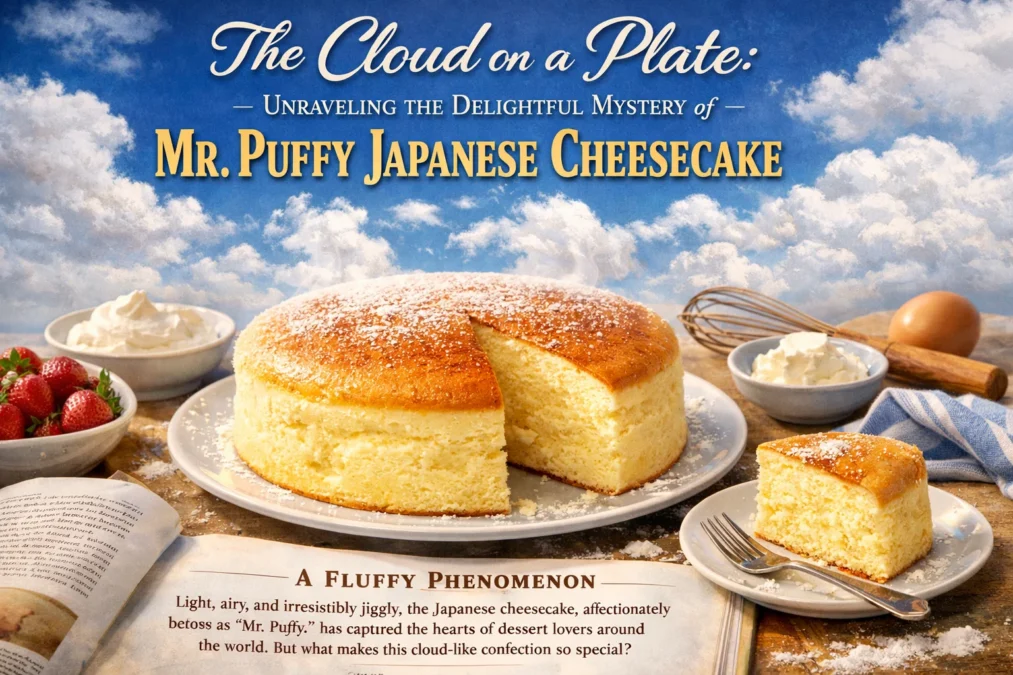

Mr. Puffy Japanese Cheesecake: Imagine a dessert that defies every expectation you have about cheesecake. It’s not dense, rich, or heavy. Instead, it’s a tall, golden-topped pillow that jiggles with a gentle tremor, like an edible cloud that’s landed on your countertop. When you slice into it, the texture is impossibly light, airy, and moist, with a subtle sweetness and a whisper of cream cheese flavor that melts on your tongue without a trace of heaviness. This is not just any dessert; this is the phenomenon known as Mr. Puffy Japanese cheesecake. Over the past decade, this unique creation has captured the hearts (and social media feeds) of food lovers worldwide, evolving from a niche bakery item into a global culinary star. But what exactly is it? Who is “Mr. Puffy”? And what sorcery is involved in creating a cheesecake that seems to float? This deep dive isn’t just a recipe—it’s a full exploration of the history, science, cultural journey, and baking artistry behind the legendary Mr. Puffy Japanese cheesecake. We’ll unpack its origins, decode the techniques for perfecting it at home, and explore why this jiggly masterpiece represents a perfect harmony of Eastern sensibility and Western indulgence.
The name Mr. Puffy Japanese cheesecake itself sparks curiosity. It sounds less like a formal pastry and more like a friendly character, which is oddly fitting. While its roots are firmly in the Japanese tradition of fuwa fuwa (fluffy fluffy) cotton cheesecakes, the “Mr. Puffy” moniker is believed to have been a branding genius from specific bakeries, possibly in Southeast Asia, that helped catapult the treat to viral fame. Videos of these majestic, trembling cakes being extracted from their pans flooded the internet, captivating viewers with their hypnotic, wobbly dance. This visual appeal, combined with a texture described as a cross between a classic New York cheesecake and a soufflé, created an irresistible mystique. To understand the Mr. Puffy Japanese cheesecake is to appreciate a delicate balance—of ingredients, of heat, of technique—where precision meets passion to create something truly magical and deceptively simple.
From Japan to the World: The Historical Journey of a Jiggly Icon
The story of the Mr. Puffy Japanese cheesecake begins, as the name implies, in Japan. Its direct ancestor is the Japanese cotton cheesecake, or fuwa fuwa chīzukēki. This style of dessert emerged post-World War II, as Western influences, particularly American food culture, began to permeate Japanese society. Ingredients like cream cheese and butter became more accessible. However, Japanese palates and culinary philosophy often favor lightness, subtlety, and refinement over extreme richness. Pastry chefs sought to adapt the heavy, dense American cheesecake into something that aligned with local tastes. The solution was ingenious: incorporate air. By deftly folding stiffly beaten egg whites—the same technique used in soufflés and angel food cakes—into the cream cheese and egg yolk base, they created a hybrid. The result was a cake that retained the distinctive, tangy flavor of cheesecake but with an ethereal, cotton-soft texture that felt entirely new.
The evolution from a domestic Japanese creation to the global “Mr. Puffy” phenomenon is a tale of 21st-century food culture. Bakeries in Taiwan, Singapore, Malaysia, and the Philippines began perfecting and popularizing their own versions. Many trace the specific “Mr. Puffy” name to successful bakery chains in these regions that standardized a particularly tall, dramatic, and visually consistent product. The rise of platforms like YouTube, Instagram, and TikTok was the ultimate catalyst. Short, satisfying clips of the Mr. Puffy Japanese cheesecake jiggling—often tapped by a finger to show its mesmerizing wobble—became addictive viewing. This wasn’t just food; it was ASMR food, a visual and textural experience that transcended language. The name “Mr. Puffy” became a catchy, searchable tag for this specific, photogenic iteration of the cotton cheesecake. It transformed a delicate pastry into an international superstar, creating long queues outside bakeries and inspiring countless home bakers to attempt their own.
Deconstructing the Cloud: The Science of What Makes It So Special
At first glance, the ingredients list for a Mr. Puffy Japanese cheesecake might look familiar: cream cheese, sugar, eggs, butter, milk, and a bit of flour. The magic, however, lies not in what’s used but in the proportions and, most critically, the physical structure created. This cake is a magnificent edible foam, a delicate network of air bubbles stabilized by egg proteins and the starch from flour. The high ratio of eggs, particularly the whites, is the key to its architecture. When egg whites are beaten, they unravel and form a network of proteins that trap air, creating a stable foam called a meringue. Incorporating this meringue into the dense, creamy base is what gives the Mr. Puffy Japanese cheesecake its signature lift and airy crumb.
The role of heat and moisture is equally scientific and delicate. Unlike a dense baked cheesecake that sets firmly, the Mr. Puffy Japanese cheesecake relies on a gentle, moist heat to rise evenly without cracking and to set that jiggly, tender structure. This is almost universally achieved through a bain-marie or water bath. The pan containing the cake batter is placed within a larger pan filled with hot water. This water bath insulates the delicate cake from the oven’s direct, fierce bottom heat, ensuring it cooks gently and evenly. The steam from the water bath also creates a humid microenvironment, preventing the surface of the cake from drying out and forming a skin too quickly, which would lead to cracking as the interior expands. The final texture—moist, creamy, yet light—is a direct result of this precise thermal management. It’s a recipe where understanding the “why” is just as important as following the “how.”
The Core Philosophy: Flavor Profile and Textural Alchemy
The flavor of a true Mr. Puffy Japanese cheesecake is an exercise in elegance and restraint. It is not an in-your-face, punchy cheesecake experience. Instead, the cream cheese flavor is present but muted, a soft, tangy backdrop rather than the starring soloist. The sweetness is gentle, never cloying, allowing the subtle dairy notes of butter and milk to come through. Often, a touch of lemon juice or zest is added, not to make it “lemony,” but to brighten the flavor profile and enhance the perception of freshness. This subtlety is intentional. The Mr. Puffy Japanese cheesecake is meant to be a clean, comforting, and almost refreshing dessert—one you can enjoy a larger slice of without feeling overwhelmed.
But let’s be honest: while flavor is important, texture is the true star of the show. The alchemy of the Mr. Puffy Japanese cheesecake creates a tripartite textural experience. First, the exterior: a thin, golden-brown top and sides that offer the faintest resistance, a delicate shell formed from the Maillard reaction in the oven’s gentle heat. Then, the crumb: as you bite, it yields with an incredible softness, almost like a set custard but with more body. It’s moist and creamy, yet simultaneously airy and faintly elastic. Finally, the melt: it dissolves on the palate almost instantly, leaving behind just a whisper of sweetness and richness. This contrast between the slight skin and the cloud-like interior is a huge part of its addictive quality. It’s a dessert that engages your senses of sight (the jiggle), touch (the soft yield), and taste (the clean finish) in a uniquely captivating way.
Gathering Your Arsenal: Essential Ingredients and Equipment
Before embarking on your quest to create the perfect Mr. Puffy Japanese cheesecake, you need to assemble your toolkit. The ingredients are simple, but quality matters. Use full-fat, brick-style cream cheese for the richest flavor and best structure. Low-fat varieties contain more water and stabilizers that can throw off your texture. Fresh, large eggs are non-negotiable; their proteins are crucial for building the meringue. Use a fine, white sugar that will dissolve completely. Cake flour is traditionally preferred over all-purpose flour because its lower protein content results in a more tender, less chewy crumb. If you only have all-purpose flour, you can make a substitute by replacing two tablespoons per cup with cornstarch, but for your first attempt, seek out cake flour. Finally, use whole milk and unsalted butter for the best flavor.
The equipment list is short but specific. You will need:
- A Stand Mixer or Hand Mixer: Whipping egg whites to the correct stiff peak stage by hand is a Herculean task. An electric mixer is essential.
- An 8-inch Round Cake Pan (preferably with a removable bottom): The removable bottom makes unmolding this fragile cake infinitely easier. If you use a solid pan, lining it meticulously with parchment paper is a must.
- A Larger Roasting Pan or Baking Dish: This will act as the vessel for your water bath (bain-marie).
- Aluminum Foil: To waterproof the bottom of your cake pan if it’s not completely sealed (many springform pans leak).
- A Fine-Mesh Sieve or Sifter: For ensuring your dry ingredients are lump-free and for achieving the smoothest possible batter.
- An Oven Thermometer: Oven temperature accuracy is critical. Relying on your oven’s built-in thermostat is a common pitfall.
Having the right tools prepared before you begin will make the process smoother and less stressful, allowing you to focus on the delicate techniques that define a successful Mr. Puffy Japanese cheesecake.
The Master Process: A Step-by-Step Guide to Baking Success
The journey to a perfect Mr. Puffy Japanese cheesecake is a ballet of careful steps. Rushing or taking shortcuts will lead to a dense, sunken, or cracked cake. Here is the method, broken down into its core phases.
Phase 1: Preparing the Base and the Meringue
Start by meticulously lining your cake pan with parchment paper on the bottom and sides. If using a springform pan, wrap the outside bottom and sides with a double layer of heavy-duty aluminum foil to prevent water seepage. Separate your eggs while they are cold—it’s easier—but let the whites come to room temperature before whipping, as they will achieve greater volume. In a heatproof bowl, combine the cream cheese, butter, and milk. Set this bowl over a pot of gently simmering water (a double boiler) and whisk until the mixture is completely smooth, lump-free, and hot to the touch. Remove it from the heat. Whisk in the egg yolks one at a time, then sift in the flour and cornstarch, whisking vigorously until you have a silky, homogeneous base. Now, in a scrupulously clean, grease-free bowl, beat the egg whites. Start on low, then increase speed as foams form. Once frothy, add cream of tartar (this stabilizes the foam), then gradually add the sugar. Whip until you reach stiff, glossy peaks—the meringue should stand straight up when the beaters are lifted.
Phase 2: The Delicate Dance of Folding and Baking
This is the most critical moment. Take one-third of your meringue and whisk it vigorously into the warm cream cheese base. This first addition loosens and lightens the dense base, making it easier to fold in the remaining meringue without deflating it. Now, add the remaining meringue in two batches. Using a flexible silicone spatula, fold gently but deliberately: cut down through the center, sweep along the bottom, and fold up and over the top, rotating the bowl as you go. Your goal is to incorporate the meringue fully while losing as little air as possible. Stop as soon as no white streaks remain. Pour the lofty, pale batter into your prepared pan. Tap the pan gently on the counter a few times to release any large air bubbles. Place the cake pan inside your larger roasting pan. Carefully pour hot (near-boiling) water into the larger pan until it comes about halfway up the sides of the cake pan. This is your water bath. Transfer the whole assembly carefully to a preheated oven, typically around 320°F (160°C). Bake for about 70-90 minutes. The top will be a deep golden brown, and the cake will have risen beautifully. It should jiggle like a firm jelly when gently shaken.
Phase 3: The Crucial Cool Down
Your work isn’t over when the oven timer dings. How you cool the Mr. Puffy Japanese cheesecake is paramount to preventing a dramatic collapse. Turn off the oven and crack the door open slightly, just an inch or two. Let the cake sit in this diminishing heat for about 60 minutes. This gradual temperature drop allows the delicate structure to set slowly. After an hour, remove the cake from the oven and water bath, peel off the foil, and let it cool completely on a wire rack at room temperature. Once completely cool, you can run a thin knife around the edge and carefully unmold it. For the cleanest slices and best texture, refrigerate it for at least 4 hours, or preferably overnight, before serving. The patience here is rewarded with a stable, sliceable, incredibly moist cloud.
Navigating Common Pitfalls: Troubleshooting Your Mr. Puffy Japanese Cheesecake
Even with careful attention, things can sometimes go awry. Understanding these common issues will help you diagnose and solve them on your next bake.
The Cake Sinks Dramatically in the Middle:
This is the heartbreak of the Mr. Puffy Japanese cheesecake. The primary culprits are underbaking or under-whipping the meringue. If the cake hasn’t set fully in the center, the structure can’t support itself as it cools. Ensure your oven temperature is accurate and bake until the top is deeply golden and the jiggle is set. Secondly, if your meringue was only at soft peaks, it doesn’t have the strength to provide the necessary lift and support. Whip those whites until they are truly stiff and glossy.
The Top Cracks Deeply:
Cracking is often a sign of too much heat or a dry oven environment. The surface sets too quickly, and as the interior continues to expand, it bursts through. Ensure you are using a water bath—it is not optional. Also, verify your oven isn’t running hot with an oven thermometer. Some bakers start at a slightly higher temperature (e.g., 340°F) for 20 minutes to encourage a rise, then lower it (to 300°F) for the remainder of the bake to gently set it without cracking. Experiment with this method if cracking persists.
The Bottom is Soggy, or the Texture is Eggy/Wet:
A soggy bottom usually indicates water leaked into the pan despite the foil. Be extra diligent with your waterproofing. An eggy or wet texture can mean the cake is simply underbaked. Use visual and tactile cues (golden top, set jiggle) over time alone. An eggy flavor can also come from not incorporating the meringue fully, leaving pockets of egg white that taste distinct. Ensure you fold until just combined, with no streaks.
It’s Dense and Doesn’t Rise High:
These points directly point to meringue issues. Either the whites were not whipped enough, they were whipped in a greasy bowl (fat prevents foaming), or the meringue was deflated during folding. Ensure all equipment is spotlessly clean and grease-free. Fold with a gentle, confident hand, and don’t overmix once the meringue is added.
Beyond the Classic: Flavor Variations and Creative Twists
Once you’ve mastered the classic Mr. Puffy Japanese cheesecake, a world of flavor variations opens up. The basic recipe is a wonderful canvas. For a Matcha Green Tea version, sift 1-2 tablespoons of high-quality culinary matcha powder with your flour. The result is a beautiful pale green cake with an earthy, sophisticated flavor. A Chocolate variation can be achieved by melting high-quality dark chocolate into the warm cream cheese mixture or by adding sifted cocoa powder with the dry ingredients. For a Citrus-Infused cake, add the zest of a lemon, orange, or yuzu to the base, complementing the inherent brightness of the cheesecake.
You can also play with inclusions and toppings. Gently fold a handful of fresh berries into the batter at the very end. After baking and cooling, a light dusting of powdered sugar or a drizzle of a simple glaze (lemon, matcha, or chocolate) adds visual appeal and a hint of extra sweetness. For a decadent twist, serve a slice with a berry compote or a dollop of lightly sweetened whipped cream. The beauty of the Mr. Puffy Japanese cheesecake is its versatility—it can be dressed up or enjoyed in its pure, simple form, always impressing with its unique texture.
The Cultural Impact: More Than Just a Dessert
The Mr. Puffy Japanese cheesecake is a fascinating case study in globalized food culture. It represents a successful “third culture” dessert: a Japanese interpretation of a Western classic, which was then re-popularized by Southeast Asian bakeries and disseminated globally via the internet. It’s a dessert that transcends language barriers; its appeal is visual and textural, requiring no translation. In an era of food media, it is the perfect subject—highly visual, process-driven, and boasting a dramatic “reveal” when unmolded or jiggled.
It also speaks to a modern desire for desserts that are indulgent yet not overly heavy. The Mr. Puffy Japanese cheesecake offers the comfort and flavor of cheesecake with a lightness that feels almost virtuous. It has spawned countless online communities where bakers share triumphs and failures, tips and photos. It has become a benchmark of baking skill for home enthusiasts. As one renowned pastry chef famously said of similar delicate desserts, “It’s not just about taste, it’s about creating an experience that engages wonder.” The Mr. Puffy Japanese cheesecake does exactly that—from the anticipation of the bake to the final, melting bite.
Frequently Asked Questions About Mr. Puffy Japanese Cheesecake
What is the difference between Mr. Puffy Japanese cheesecake and regular cheesecake?
The difference is fundamental. A regular New York-style cheesecake is dense, rich, and heavy, with a crust and a firm, creamy filling that relies on a high ratio of cream cheese and eggs set with slow baking. A Mr. Puffy Japanese cheesecake is light, airy, and jiggly. It contains less cream cheese and uses a high proportion of whipped egg whites (a meringue) to leaven it, giving it a soufflé-like texture. It’s baked in a water bath for gentle, even cooking and has no crust. The experience is more like eating a sweet, cheesy cloud than a thick, decadent slice.
Why did my Mr. Puffy Japanese cheesecake collapse?
Collapse is usually due to two main issues: underbaking or problems with the meringue. If the cake’s internal structure hasn’t set completely before cooling, it will fall. Ensure you bake until the top is deep golden, and it jiggles as one unit, not liquidly. Secondly, if the egg whites were under-whipped or if the meringue was deflated during folding, the cake won’t have enough airy structure to support itself as it cools. Always whip to stiff, glossy peaks and fold with a gentle hand.
Can I make a Mr. Puffy Japanese cheesecake without a water bath?
It is highly, highly discouraged. The water bath (bain-marie) is not a suggestion; it is the core technique that ensures gentle, moist, even heat. Without it, the oven’s direct heat will cause the exterior to set too quickly, leading to cracking, uneven rising, and a dense or rubbery texture. The steam from the water bath is also crucial for achieving the signature moist, tender crumb. For authentic results, the water bath is non-negotiable.
How should I store leftovers, and how long do they last?
Store your Mr. Puffy Japanese cheesecake covered in the refrigerator. Due to its high moisture content, it is best consumed within 2-3 days for optimal texture and flavor. You can also freeze it. To freeze, wrap the whole cake or individual slices tightly in plastic wrap, then in aluminum foil, or place in an airtight container. It can be frozen for up to a month. Thaw overnight in the refrigerator before serving.
Is Mr. Puffy’s Japanese cheesecake served warm or cold?
It is almost always served chilled. The refrigeration time (at least 4 hours) allows the structure to firm up completely, making it much easier to slice cleanly and delivering the perfect cool, creamy, cloud-like texture. Serving it warm or at room temperature right after baking will result in a texture that is too soft and fragile to handle properly, and the flavors are more defined when cold.
Conclusion
The Mr. Puffy Japanese cheesecake is more than a passing food trend. It is a testament to culinary innovation and cross-cultural dialogue, a dessert that turns simple ingredients into something that feels like magic. Mastering it is a rewarding journey that teaches patience, precision, and respect for process. From its quiet origins in Japan to its viral global fame, this jiggly marvel has earned its place in the pantheon of beloved desserts. Whether you queue at a famous bakery or dare to create your own in a home kitchen, the moment you slice into that tall, golden cloud and taste its ethereal lightness, you understand the hype. It’s a delightful paradox—a cheesecake that’s not heavy, a cloud you can eat, and a baking challenge that yields a profoundly satisfying reward. The Mr. Puffy Japanese cheesecake isn’t just a treat; it’s an experience, a delicious proof that sometimes, the lightest things can make the most significant impression.